Beyond Pearl Harbor: The Other Japanese Attacks That Changed Geopolitics
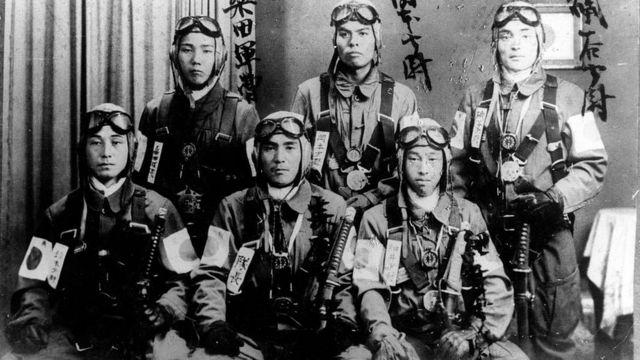
In addition to Pearl Harbor, Japanese forces bombed five other targets in the Pacific
That dawn, Japanese imperial forces advanced through the darkness and launched a series of air strikes that took the Western powers by surprise, starting World War II in the Pacific.
At that time, the sun had not yet risen in Hawaii, and the bombing of Pearl Harbor was still more than an hour away.
Although traditionally reference is made to the attack on this American naval base, located in Honolulu, as the starting point for the Pacific War, on December 7, 1941 the Imperial Japanese Navy launched a series of coordinated attacks parallel to the one at Pearl Harbor that lasted about seven hours against US and UK-controlled territories in Southeast Asia.
In an overwhelming offensive, Japan defeated US forces in Guam and the Wake Islands, as well as the Philippines; and he did the same with UK troops in Hong Kong and what was then called British Malaysia.
The Japanese victories were very, very fast; and when they entrenched, they made it very difficult for the Allies to regain those areas," says Mark Roehrs, professor of history at Lincoln Land Community College in Illinois, USA, and co-author of the book World War II in the Pacific on BBC News Mundo, the BBC's Spanish-language news service.
paving the way for war
Japan was not at war with either the United States or the United Kingdom when it attacked those territories in Asia. However, it had been immersed since 1937 in a regional war with China that generated friction with the West.
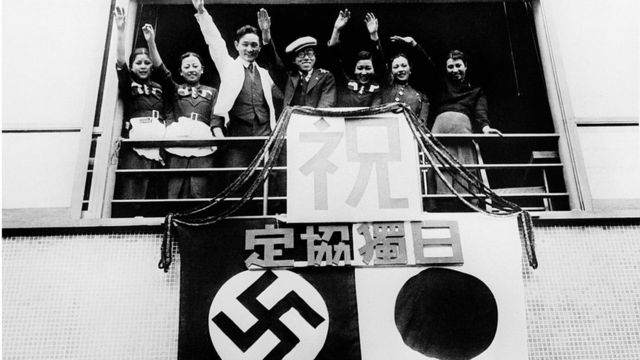
Although Japan did not formally enter World War II until Pearl Harbor, the Asian country already had a mutual support pact with Nazi Germany

"The main reason Japan was expanding into the Pacific is because their own territory is not very rich in natural resources, so they wanted to get colonial possessions that would provide them with the resources they needed. They were looking for things like rubber, rice, tin and bauxite, resources you would find in the islands of the central and southern Pacific," says Roehrs.
Of all the raw materials, what Japan needed most was oil.
"Oil was the really crucial issue, because the Japanese had nothing, and if they were going to fight a war, they needed a safe source of oil," says Raymond Callahan, professor emeritus of history at the University of Delaware, USA, to BBC News World.
He points out that, paradoxically, the territories that the Japanese simultaneously attacked Pearl Harbor were not particularly rich in these resources.
“The oil fields they were targeting weren't actually in the Philippines or British Malaysia. They were in the Dutch East Indies, now Indonesia. And they knew they had to eliminate American forces in the Philippines and British troops in British Malaysia and Singapore, because these forces were on the margins of the Japanese route to the south, towards the Dutch East Indies", he explains.
Since most of the European powers had transferred their local forces to the Old Continent to fight the war that was taking place there, the biggest obstacle facing the Japanese in the Pacific was the military presence of the United States.
"The reason Japan attacked the United States was to try to neutralize its fleet, the only force that remained intact and that posed a real threat to Japan's advances in the South and Southwest Pacific," notes Roehrs.
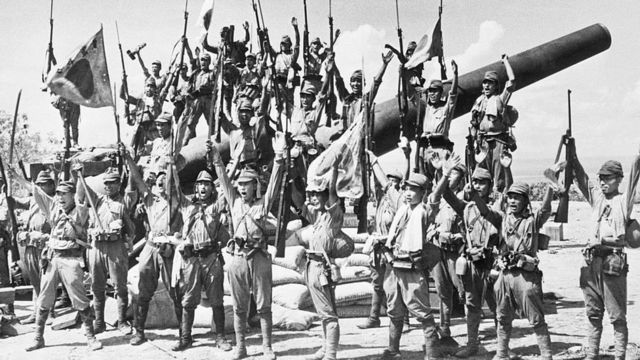
The United States' defeat in the Philippines was a significant achievement for Japan
The historian emphasizes that, in general, the territories attacked were seen as "aircraft carriers that could not be sunk" and that, from a military point of view, the most important was the Philippines.
"The British, the French, the Dutch had exhausted their defensive forces, and the American fleet at Pearl Harbor and the Philippines was the main military threat facing the Japanese," he says.
In the Philippines, the United States had a force of about 100,000 men commanded by the famous General Douglas MacArthur.
Quick victories, lasting humiliation
With the coordinated and simultaneous attack against all these targets, Japan sought to obtain a swift and decisive victory.
"The Japanese knew they couldn't withstand a long war of attrition, so part of what they were looking for with this quick series of attacks was not just to defeat Allied forces on the ground, but also to gain a psychological victory that would make opponents think it would be too much. difficult or that it was simply not worth trying to regain these territories," says Roehrs.
And, in fact, they managed to assert themselves relatively quickly and easily.
After being bombed for two days, Guam was occupied on December 10, 1941 by an unstoppable ground invasion. Though she managed to hold out for a few more weeks, earning her the title of "Poplar" of the Pacific, Wake Island met a similar fate.
"Both the US Navy and Army believed that it was not possible to defend those islands. The plan was to keep small garrisons there that would fight to the best of their abilities and then surrender. Their loss was already taken for granted, before the war begins," explains historian Raymond Callahan.
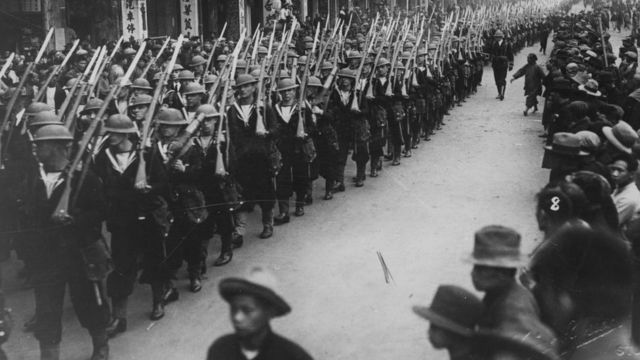
British forces in Hong Kong were numerous, but defense of this colony became difficult after southern China fell to Japan.
A similar situation happened in Hong Kong. Months before the start of the war, British military leaders came to the conclusion that it was not possible to defend that colony, although in the end they agreed to strengthen it somewhat by sending more troops.
“Hong Kong's water supply came from mainland China, so once they lost control over this reservoir, they wouldn't be able to hold out much longer, no matter how many soldiers there were,” explains Callahan.
"The Hong Kong garrison had about five or six battalions, half of them Canadian. They fought well, but it really was impossible."
Although it had better defense resources and was the most important British military base and port in Southeast Asia, Singapore was occupied in just over two months.
"We could talk for four hours about the things that went wrong in Singapore. There, as the saying goes, 'Everything that could go wrong, went wrong.' All the assumptions and hunches from the prewar period were incorrect," says Callahan.
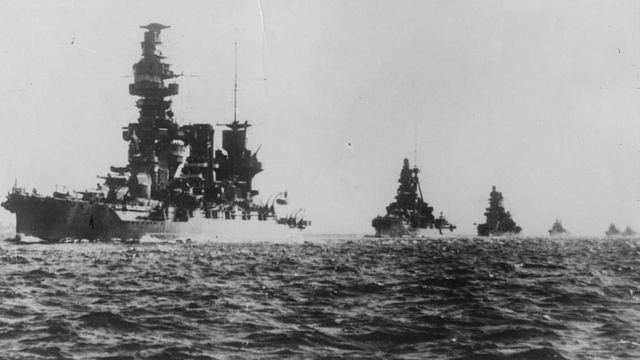
Japan's plan was to conquer territories rich in raw materials and free up sea lanes to drain them
He says that one of the elements that favored the Japanese was that Nazi Germany gave them secret British documents it had intercepted and which included the UK's assessment of Singapore's defense capabilities, so they had a unique advantage. when planning your attack.
The then British Prime Minister, Winston Churchill, ordered the island to be defended, but the mistakes of the military commanders on the ground caused some 80,000 British, Indian and Australian soldiers to surrender on February 15, 1942 to a Japanese force. of about 40,000 men.
"It is the worst disaster and the greatest surrender of forces in British history," Churchill lamented.
Although the Philippines did not fall into Japanese hands until May 1942, defeat would spell a lasting stain on the military history of the United States, which had controlled the archipelago since 1898.
"The defeat in the Philippines was very disgraceful because the United States invested there, General Douglas MacArthur was there and, at least on paper, there was a force of about 100,000 men made up of US soldiers and US-trained Filipino soldiers," he notes Roehrs, noting that, despite these conditions, the Japanese moved forward relatively quickly.
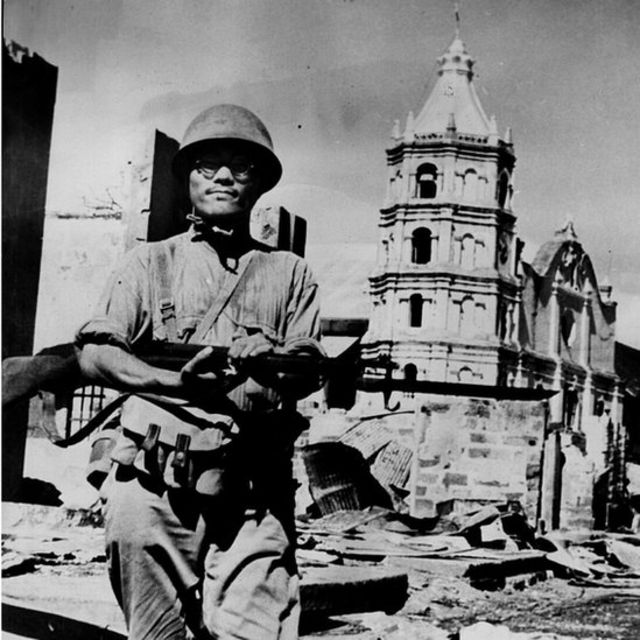
In less than six months, Japan had already conquered the targets it attacked in South Asia in December 1941
"The case of the Philippines is really inexplicable because news of the Japanese attack on Pearl Harbor had already reached the island when Japanese bombers attacked Clark Field, north of Manila, where most of the American air force was concentrated, and the MacArthur's B17 attack planes were parked side by side at the air base as if it were still a time of peace," says Callahan.
"There is still no adequate explanation today as to why MacArthur's bombers were found parked on the ground," he adds.
geopolitical changes
The Japanese defeat in 1945 and the subsequent surrender of the country on September 2 of that year, signed aboard a US warship and in the presence of General MacArthur, ended World War II in the Pacific.
However, the military defeat that Japanese forces inflicted on the Western powers with the December 7, 1941 attacks (December 8, Wake Island, Guam, Hong Kong, Singapore and the Philippines) would have lasting consequences.
"The long-term consequence of these Japanese attacks is that they dealt a fatal blow to European colonial empires in Southeast Asia," says Raymond Callahan.
The historian explains that France's control over Indochina (Vietnam), the Netherlands over Indonesia, or the United Kingdom over Singapore was based in part on that region of Asia's belief that European armies were unbeatable.
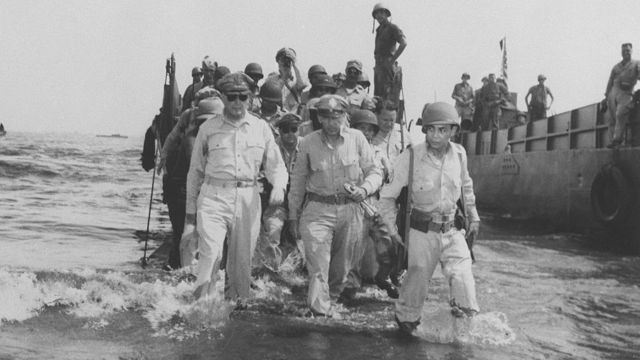
After leaving the Philippines in 1942, General Douglas MacArthur returned victorious in 1944
He points out that seeing American and British soldiers surrender to Asian troops has had a huge impact on the minds of people in that region of the world.
"This destroyed the prestige of the European settlers, which could never be regained. In fact, I think a parallel can be drawn between what happened during the first six months of the war in the Pacific and what happened in the 1940s, 1950s and 1960s in Southeast Asia," says Callahan.
After the end of the Japanese occupation, the Philippines gained its independence in 1946, the British withdrew from Singapore and Malaysia, the Netherlands lost control over Indonesia; and France, first, and the United States, later, are defeated in Indochina (Vietnam).
"The British Empire in Asia lasted another five or six years after the war. The British came back there as victors, but they immediately had to prepare to leave again," he adds.
Callahan recalls that one of the goals Japan set itself in the war was to eliminate European influence in Asia.
"Paradoxically, although the Japanese have finally been defeated, we can say that this objective has been achieved", he concludes.


No comments:
Post a Comment