Is Russia Closer to Invading Ukraine? The new developments of the crisis

Russian TV showed, in early 2022, tank exercises near the border with Ukraine
Is the Russian army preparing for a war with Ukraine? US President Joe Biden is certainly expecting some sort of military move from Moscow in the Eastern European country.
Russia wants the West to promise that Ukraine will not be part of NATO (North Atlantic Treaty Organization, the western military alliance), but while the two sides are negotiating, that Russian wish will not be granted. What happens from now on could jeopardize Europe's entire security structure.
Below, the most recent developments of the crisis, divided into seven points:
Why is Russia threatening Ukraine?
Russia denies that it is planning an invasion of Ukraine, but it has taken part of Ukrainian territory before. In addition, it is estimated that Moscow has 100,000 troops near the border between the two countries.
On Friday, Russian Foreign Minister Sergei Lavrov met with US Secretary of State Anthony Blinken for "frank" talks to try to reduce the chances of a wider conflict in Ukraine. While Lavrov again denied that the numerous Russian troops on the border were preparing for an invasion, Blinken said the US would respond harshly if that happened, including new sanctions on Moscow.
Russia has long tried to block any move by Ukraine towards European institutions and NATO in particular. Ukraine borders both the European Union and Russia, but as a former Soviet republic it has deep social and cultural ties to Russia. Russian is widely spoken in Ukraine.
When Ukrainians ousted pro-Russian President Viktor Yanukovych in 2014, Russia annexed Ukraine's Crimea peninsula and supported Moscow-aligned separatist forces who captured vast swaths of eastern Ukraine. Since then, the rebels have continued to fight Ukrainian forces in the region, in a conflict that has left more than 14,000 dead.
How big is the risk of an invasion?

End of Podcast
Russia says it has no plans to attack Ukraine. The head of the Russian Armed Forces, Valery Gerasimov, even called the reports of an imminent invasion liars.
Tensions, however, are high, and Russian President Vladimir Putin has threatened "appropriate techno-military retaliatory measures" if what he calls the West's aggressive approach continues.
The US, in turn, accused Russia, on 1/14, of sending saboteurs to eastern Ukraine to simulate an incident or confrontation that served as a justification for Russian military action in the neighboring country. A few days later, at a news conference, when asked by journalists about the tensions, President Joe Biden replied: "Do I think he (Putin) is going to test the West, the US and NATO as much as he can? Yes. But I think he will pay a heavy price and regret it."
NATO Secretary General Jens Stoltenberg also warned that the risk of military conflict was real.

Russian military exercises in Crimea in 2021 worried Western governments
The US says Russia has offered no explanation as to why US troops were deployed near Ukraine — and Russian soldiers and tanks were sent to Moscow-allied Belarus for military exercises.
Russian Deputy Foreign Minister Sergei Ryabkov compared the current situation to the Cuban Missile Crisis of 1962, when the US and Soviet Union came close to nuclear conflict. The US intelligence service suggests that a Russian incursion or even invasion of Ukraine could take place as early as 2022.
What does Russia want from NATO?
Russia spoke of a "moment of truth" when referring to a reconfiguration of its relationship with NATO. "For us, it is absolutely mandatory to ensure that Ukraine never, ever becomes a member of NATO," said the Russian deputy foreign minister.
Moscow accuses NATO member states of "filling" Ukraine with weapons and the US of fueling tensions. President Putin complained that Russia "has nowhere else to retreat. Do they think we're just going to sit around and watch?"
In reality, Russia wants NATO to return to its pre-1997 borders. The country demands that there be no further eastward expansion and wants an end to NATO's military activities in Eastern Europe. This would mean the withdrawal of combat units from Poland and the Baltic republics — Estonia, Latvia and Lithuania — and that no missiles are deployed in countries like Poland and Romania.
Russia has also proposed a treaty with the US preventing nuclear weapons from being installed outside its national territories.
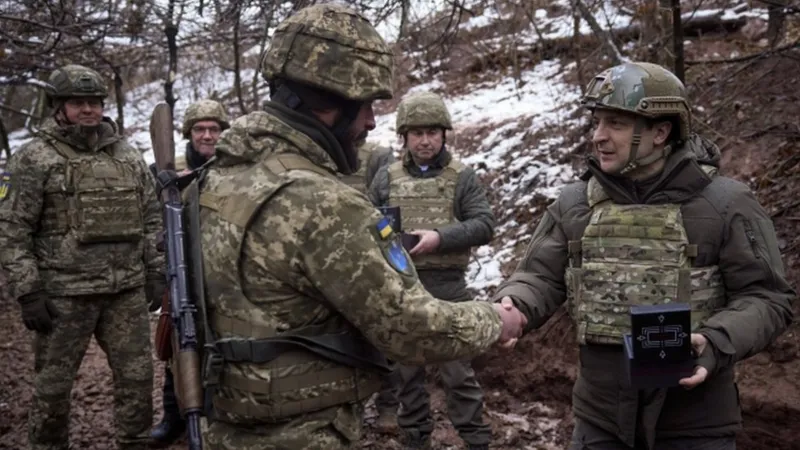
Ukrainian President Volodymyr Zelensky (right) visited Ukrainian troops in December
What does Russia want in Ukraine?
Russia took over Crimea in 2014 on the grounds that it had a legitimate historical claim to the territory. Ukraine was part of the Soviet Union, which disintegrated in 1991. Putin claimed that this collapse was the "disintegration of historic Russia".
An indication of what Putin thinks about Ukraine came in a lengthy text last year in which he said Russians and Ukrainians formed "one nation". He accused Ukraine's current leaders of carrying out an "anti-Russia project".
Russia was also frustrated that a peace agreement for eastern Ukraine, established in 2015 in Minsk (Belarus), is far from fully implemented.
There are still no arrangements for holding independently monitored elections in Ukraine's breakaway regions. Russia denies accusations that it is involved in the local conflict.
Can an action by Russia be stopped?
Putin has spoken to Biden about the crisis several times, and high-level talks continue. Russian officials, however, warn that the West's rejection of their main demands is pushing the crisis into a "dead end".
The question is how far will Russia go. Biden warned that a full-scale invasion would be a disaster for Russia. If the country does, however, carry out a small-scale territorial incursion, the US president controversially claimed that the West "would end up having to debate what to do".
The White House stressed that any movement across the border constitutes a new invasion — but points to the fact that Russia has other weapons, including cyber attacks and paramilitary tactics.

US Secretary Antony Blinken met with Russian Sergei Lavrov in Switzerland
Russia also distributed 500,000 passports to residents of rebel-held areas in Ukraine. With that, if it doesn't get what it wants, Moscow could justify some military action by saying that it aimed to protect Russian citizens in the region.
However, if Russia's only objective is to force NATO away from its neighborhood, there is no sign that it will succeed.
NATO's 30 member states have clearly rejected any attempt to tie their hands on the future. "We will not allow anyone to shut down NATO's open-door policy," said US Deputy Secretary of State Wendy Sherman.
Ukraine is seeking a clear timetable for joining NATO, and the organization says Russia "has no veto power or right to interfere in this process."
Sweden and Finland, Nordic nations that are not part of NATO, also rejected Russia's attempt to stop them from strengthening their ties to the Western military alliance. "We will not abandon our wiggle room," said Finnish Prime Minister Sanna Marin.
How far will the West go for Ukraine?
The US has made it clear that it has no plans to send combat troops to the region, although it remains committed to helping Ukraine defend its "sovereign territory".
The main tools the West has possessed appear to be sanctions against Russia and military aid to Ukraine in the form of advisers and weapons.
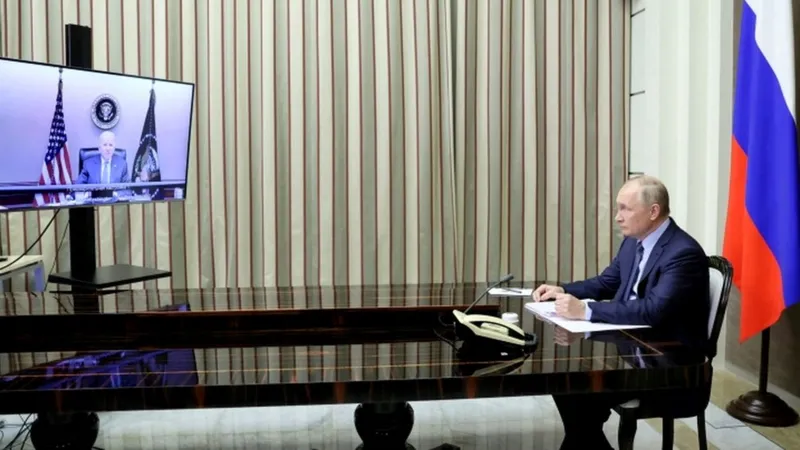
The presidents of the US and Russia have already talked several times about the crisis
President Biden has threatened the Russian leader with measures "he has never seen" if Ukraine is attacked. But what kind of measures would those be?
The most impactful economic measure would be to disconnect Russia's banking system from the Swift international payments system. This has always been seen as a sort of last resort, but Latvia recently said it would serve as a hard message for Moscow.
Last week, Democratic US senators introduced a bill imposing direct sanctions on the Russian government (including Vladimir Putin) and Moscow's financial institutions. These would be in addition to pre-existing sanctions, which have been in place since 2014 (because of the annexation of Crimea) and increased after the poisoning of a Russian spy in the UK and accusations of Russian interference in the 2016 US elections (which Russia denies)..
Another key threat would be blocking the opening of the Nord Stream 2 gas pipeline system in Germany, whose approval is currently being decided by the German energy regulator.
There could also be measures against Russia's RDIF sovereign wealth fund, or restrictions on bank transactions converting the Russian ruble into foreign currencies.

Ukrainian soldiers have been patrolling the border amid the snow, facing the risk of invasion
Is the West united?
The US said it was committed to "working in perfect harmony" with its allies, but there are divisions between the US and Europe.
European leaders are determined in their position that Russia cannot decide the future with the United States alone. France has even proposed that Europeans work together with NATO and then conduct their own dialogue with Russia.
Ukraine's President Volodymyr Zelensky wants an international summit involving France and Germany, along with Russia, to resolve the crisis.


No comments:
Post a Comment