US elections: why are final results taking so long?
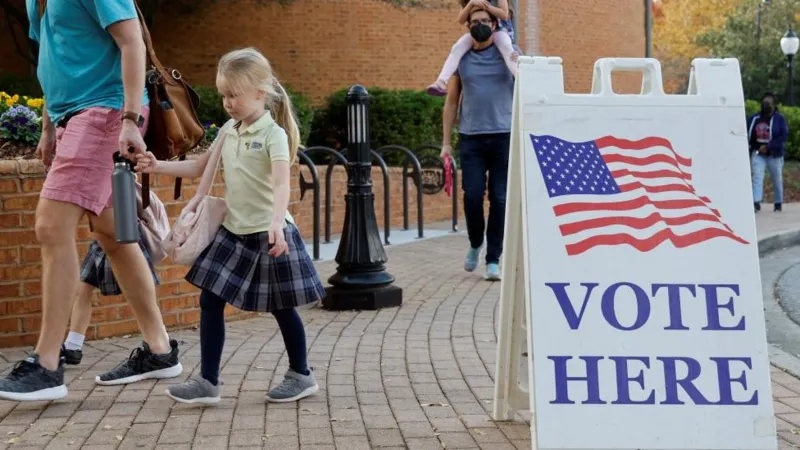
Georgia will have a runoff in December to decide the Senate seat
Days after US voters went to the polls, the final results of the US midterm elections remain open - with officials across the country warning it could still be a few weeks away. In these elections, all seats in the Chamber and a third of the Senate are renewed.
The delays are the result of a number of factors, including minimal margins between candidates and the fact that Georgia — a key battleground for Senate control — is heading for a second round.
Other delays are due to the decentralized way elections are organized in the US, where states have varying rules on how and when mailed ballots are counted. There are states where voters can choose between early voting, voting by mail, electronic voting and simply voting on paper ballots, which further delays the counting and disclosure of final results.
The issue of delays has been politically contentious since the 2020 presidential election, when then-President-elect Donald Trump tried to claim victory the next morning while votes were still being tallied, claiming the ongoing poll was an attempt at "fraud." " and an "embarrassment".
This week, Trump once again cast doubt on the process, taking to his social media platform, Truth Social, to call several state elections a "disaster for voter integrity" and accuse his political opponents of "trying to steal the election with bad machines and delays".
Prior to the midterm elections, however, election officials across the country had warned the public that delays are a normal and expected part of the US election.
In a November 2 speech, US President Joe Biden also spoke out, warning that "it is important for citizens to be patient" as votes are counted "in a legal and orderly manner".
Next, we analyze each of the factors that contribute to the delay in the investigation.
Voting by mail and early

João Fellet tries to understand how Brazilians reached the current degree of division.
episodes
End of Podcast
While final numbers have yet to be released, preliminary data from the US Elections Project suggest that more than 112.34 million Americans — about 47 percent of eligible voters — participated in this year's midterm elections.
Despite the overall number being lower than the number of voters who participated in the 2018 midterm elections, turnout in some states appears to have reached all-time highs.
And in this election, 42 million people filled out their ballots — in early voting and by mail — before November 8, surpassing the 2018 total of 39.1 million. This is one of the main factors leading to the delay in counting. Different states have different rules about how mailed ballots are processed.
Pennsylvania, for example, is one of eight states that only allowed election officials to begin processing votes on Election Day. In Maryland, on the other hand, state regulations stipulate that ballot processing cannot begin before 10 am local time the morning after the election.
Similarly, 16 states and Washington DC do not allow counting to begin until polling closes on election day, while 23 states allow counting to begin earlier on the same day. Only 10 states allow ballots to be processed and counted before November 8.
Nineteen states also have a grace period that allows for the subsequent counting of votes, provided they are sent by post until election day. In California, for example, ballots can still be received for another full week. In Arizona, on the other hand, ballots must arrive by Election Day, although officials have 20 days to come up with the final count.

Arizona Secretary of State Katie Hobbs, candidate for governor, said quick result 'will not happen'
Recount and second round
Delays can also be caused by recounts, which can occur in disputes with extremely tight margins of victory or, in many states, when requested by one of the candidates in the race.
While the process varies slightly by state, 41 states and Washington DC allow recounts to be requested. Twenty-two states have provisions for automatic recounts.
In Georgia — where Democratic Senator Raphael Warnock and Republican Herschel Walker are in competition — winning candidates must obtain at least 50% of the vote.
As there was a third candidate in the running, none of them managed to reach the required percentage of votes, leading the dispute to the second round on 6 December. This scenario is a repeat of the 2020 election in the state.
"At the end of the day, everyone wants to know that we have honest and fair elections, and we do," Georgia Secretary of State Brad Raffensperger declared Nov. 9.
"I'm going to ask voters to come out and vote one last time."

Vote count in Maricopa County, Arizona being overseen Nov. 9
Where are the delays occurring?
While the final count of votes is still taking place across the country, the delays were most evident in Arizona — where the vast majority of people choose to vote by mail. Ahead of the midterm elections, officials warned that the process could take up to 12 days.
State voters also have five days to correct their signature if requested by the authorities.
"As much as we all want to see the winner on election night in these tight races, it's just not going to happen," said Arizona Secretary of State Katie Hobbs, who is also running for governor, in October.
"These things take time."
As of Wednesday (11/9), hundreds of thousands of ballots had not yet been counted, including about 400,000 in Maricopa County and approximately 159,000 in Pima County, where officials said the count should not be finalized. before November 14th or 15th.
After problems with ballot printers were reported on Election Day, Maricopa County promised that votes would be "counted safely and accurately". While the problems were "frustrating" and "inconvenient", officials said the final count would not be affected.
Trump-backed gubernatorial candidate Kari Lake has repeatedly cast doubt on the system. In a speech on election night at her campaign committee headquarters, she hinted that "incompetence" was preventing "honest elections".
"The system we have now doesn't work," he added.
Votes are also still being counted in Nevada, where tens of thousands of ballots have yet to be counted in Clark County, Las Vegas. Representatives from both political parties urged voters to be patient.
Do delays in the results of elections happen in other countries?
While delays in election results occur in other countries, the US stands out in terms of the length of delays — largely due to its decentralized system.
For example, the results of the second round of elections in Brazil, on October 30, were known on the same day. And the results of Israel's November 1 elections were announced on November 3.
Of European countries, Sweden is considered to be one where high voter turnout and narrow margins of difference often drag the poll over a period of several days. The preliminary results of the country's 9/11 general election were not released until 15 September, and the official results after about a week later.
In 2019, it took more than a month for the results of the April 17 presidential election in Indonesia to be announced on May 21 — which, in fact, was ahead of schedule. Vote counting in the country's more than 800,000 polling stations is largely done manually in public.
General elections in India, the world's largest democracy, also last more than a month. In 2019, the Indian electoral college was over 900 million people and the turnout was nearly 70%. The results were declared more than a month after voting began.


No comments:
Post a Comment