5 controversial policies that survived Biden's onslaught against Trump's legacy
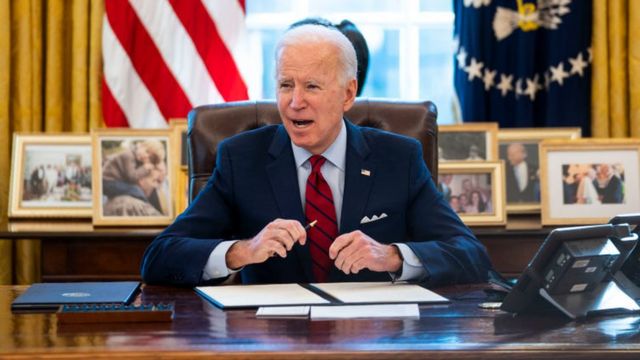
Biden signed several executive orders reversing Trump's policies
Many see the President of the United States, Joe Biden, and his predecessor in the White House, Donald Trump, in totally opposite poles. This is confirmed by the large number of Trump decisions that Biden tried to reverse in the first two weeks of his government.
This Tuesday (2/2), Biden signed a series of executive orders aimed at reversing the rigid immigration policy of his predecessor.
And during his first week at the White House alone, Biden issued a total of 21 executive orders, more than the sum issued over the same period by four previous U.S. presidents, from Bill Clinton in 1994 to Trump in 2016.
The purpose of a substantial part of these decisions was to reverse the policies implemented by Trump.
1. Abraham's Agreements
One of the hallmarks of the Trump administration's foreign policy are the so-called Abraham Agreements, whereby - thanks to the support of the United States - Israel normalized its relations with the United Arab Emirates, Bahrain, Morocco and Sudan.
Signed in 2020, these agreements were presented at the time by the White House as a historic step in the search for peace in the Middle East, for facilitating the establishment of relations between the Israeli state and the Arab countries, something almost unprecedented because until then Israel had only relations with Egypt and Jordan.
At the same time, these new agreements were criticized because they indirectly weakened the Palestinians' position in their claims to Israel, since, historically, one of the ways in which Arab countries supported them was by refusing to recognize the Israeli state.
Another criticism of these agreements was that, to make them a reality, the United States made some important concessions, such as agreeing to sell 50 next-generation F-35 fighters to the United Arab Emirates.
Last week, the new US Secretary of State, Anthony Blinken, supported these agreements, calling them "a very positive step forward" and announcing that the Biden Presidency plans to build its policies based on them.
However, the new government has also announced that it will review the sale of the fighter jets to the United Arab Emirates, which - although it is considered a usual procedure when there are changes in government - could affect these agreements if Washington eventually withdraws from the operation.
2. Hard line with China
One policy that marked the Trump era - enshrining a fundamental difference from its predecessors in the White House over the past 40 years - was the adoption of a policy of open confrontation with China.
Although the presidents before him did not avoid criticizing Beijing on issues such as the human rights situation or its commercial practices, Trump not only took a more severe tone, he also launched a trade war with China and adopted sanctions against some of his main companies like tech giant Huawei.
During the Senate confirmation hearing, Blinken said he thought Trump was right to take a tougher stance on Beijing and that he had no doubt that that nation represents the most significant challenge for the United States.
The new secretary of state also said he agreed with the opinion of his predecessor, Mike Pompeo, who stressed that China is committing genocide against Uighurs and other Muslim minorities in the Xinjiang region.
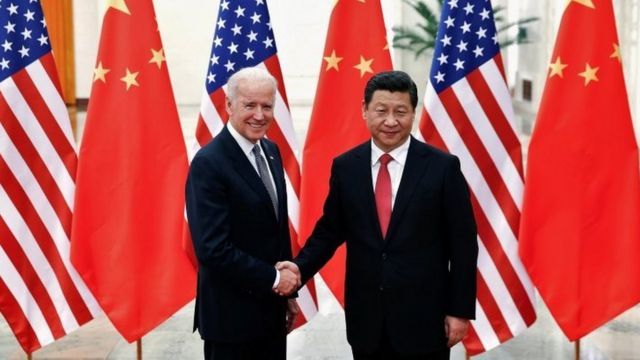
Biden government has not changed its stance with China
As for the trade war, Biden said he will hurry on issues such as tariff lifting and apply policies against China's "abusive practices", such as "intellectual property theft, illegal business subsidies" or the forced technology transfers that American companies need to operate in China.
Thus, experts anticipate that the main difference between Trump and Biden's policy towards China will lie in methods and forms: while the former president has chosen to act unilaterally, Biden must seek allies on the international stage to negotiate with Beijing.
3. $ 2,000 financial aid
When, in mid-December, the United States Congress reached an agreement for a second economic aid package in the face of the coronavirus pandemic, which included checks for $ 600 for each citizen, Trump threatened to veto the agreement if that amount was not increased to $ 2,000.
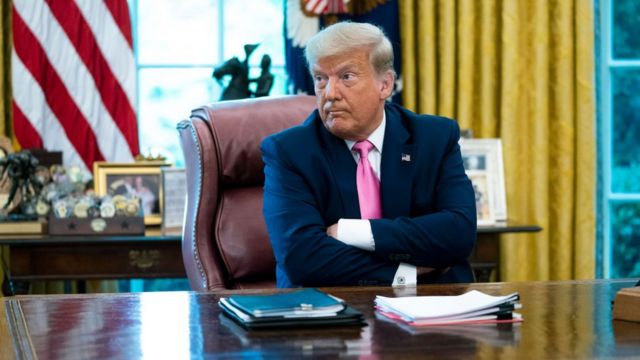
Trump even threatened to block the entire economic stimulus package if payments to citizens did not increase to $ 2,000
The then president said the amount approved was "ridiculously low".
Biden at the time called the approved aid "a first installment" and said that much more money would be needed.
After his arrival at the White House, the new president maintained that stance, and his new economic stimulus plan includes a check for $ 1,400 for each American, which will serve to complete the amount set by Trump in December.
4. Migration agreements with Mexico and Central America
Reversing Trump's immigration policies is what Biden has been working most actively on.
The new president accuses Trump of having acted at the expense of the American tradition of receiving persecuted people from different parts of the world, imposing numerous limitations on his entry and stay in the country.
These measures include the Protocol for the Protection of Migrants (PPM), which states that asylum seekers in the United States who first arrive in Mexico must wait in that country until they receive a response to their request.
The Trump administration has also signed so-called "safe third country" agreements with Guatemala, Honduras and El Salvador, which allow these countries to host people seeking refuge in the United States.
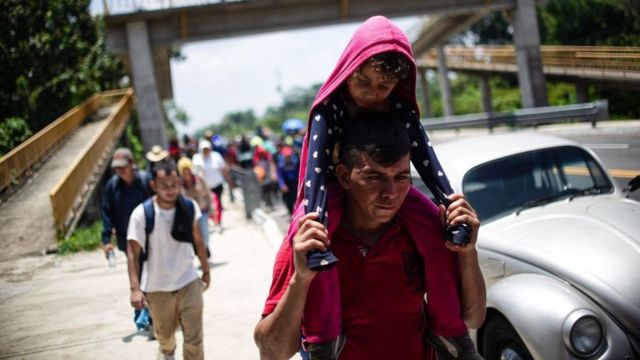
Trump tried to block caravan traffic to the United States with thousands of Central American migrants
During the presidential campaign, Biden said the PPM would be eliminated on his first day in office.
However, once elected, during a news conference in December, Biden changed his tone.
"It will be done and it will be done soon, but it will not be possible on the first day," he said, warning that he could not suddenly remove all existing restrictions, as he would risk creating an additional crisis that would complicate his efforts. government.
After nearly two weeks at the White House, Biden finally addressed the PPM issue by signing an executive order in which, while not eliminating this mechanism, he orders it to be reviewed by government officials. The program currently forces thousands of Central Americans to wait in camps on the Mexican side of the border.
During the first phone call between Biden and the president of Mexico, Andrés Manuel López Obrador, the two spoke of reversing the "draconian measures" on immigration imposed by the Trump administration.
However, they also referred to the "increased resettlement capacity", according to the call summary released by the White House.
This raises doubts about whether the new government intends to eliminate this program altogether or whether it intends to seek a different formula that also includes the possibility that Mexico will continue to receive Central Americans seeking asylum or refuge in the United States.
The idea of relocating asylum seekers is also present among the proposals that Biden addressed while still a candidate.
According to his campaign website, the new president plans to convene a regional summit that includes leaders from El Salvador, Guatemala, Honduras, Mexico and Canada "to address the factors that drive migration and propose a regional resettlement solution".
It remains to be seen how different this "resettlement solution" will be from the current agreements with Mexico and Central America.
5. Venezuela, Guaidó and Maduro
The Trump administration was the first in the world to recognize opponent Juan Guaidó as interim president of Venezuela in January 2019, after that country's president, Nicolás Maduro, was re-elected to office in elections that much of the international community considered fraudulent. .
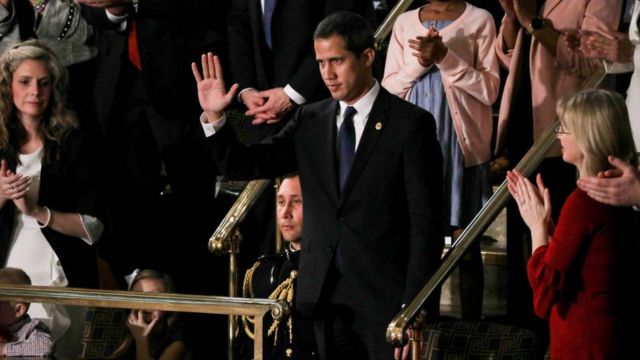
In 2020, Juan Guaidó was applauded in the United States Congress by Republicans and Democrats
Since then, Trump has imposed a series of strong sanctions not only on members of the Maduro government, but also on the Venezuelan oil industry, that country's main source of foreign exchange.
In January, the countries of the European Union decided to stop recognizing Guaidó as interim president, due to the end of the constitutional term for which the National Assembly he presided over had been elected.
However, Trump has chosen to maintain that recognition and the new U.S. government has announced that it will do the same.
Although Biden criticized some of Trump's policies in Venezuela - such as his veiled threats to use force to push for regime change in the country - the new president agrees with his predecessor in describing Maduro as a "tyrant" and is in favor of the increase sanctions against the government and its allies.
Biden also called on other countries to recognize Guaidó as the country's legitimate leader and to advocate the release of political prisoners and the holding of new elections in Venezuela.


No comments:
Post a Comment