Coronavirus: how Portugal, an example in the 1st wave of the pandemic, reached the brink of collapse in the 2nd
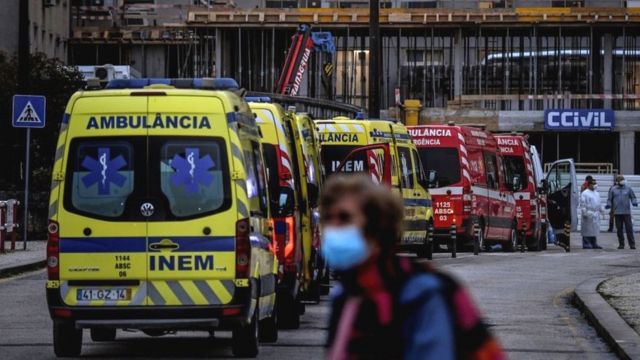
Row of ambulances at a Lisbon hospital illustrates the difficulties experienced in Portugal
The current situation in Portugal due to the new coronavirus is dramatic.
The European country had been relatively successful in combating covid-19 during the first wave of the pandemic. However, cases have skyrocketed recently. This caused an overload on the health system. Field hospitals were opened and patients had to be transferred to health facilities on a Portuguese island. There is even a plan to send some patients to other countries.
In the last two weeks of January, Portugal registered the highest covid-19 infection rate in the European Union: 1,429.43 per 100 thousand inhabitants, according to data from the European Center for the Prevention and Control of Diseases (ECDC, for its acronyms) in English).
The country also has the highest death rate in the European Union: 247.55 per million inhabitants. From the first cases recorded in the beginning of 2020 until the last Monday (01/02), Portugal has already had 12.7 thousand deaths from the new coronavirus and 726.3 thousand infected.
Health authorities and experts attribute the increase in cases and deaths to two main factors: the expansion of the British variant of the new coronavirus, which is more contagious, and a great relaxation of social isolation during the holidays.
Collapsing hospitals
Several parts of the country, with 10 million inhabitants, have hospitals in a calamity situation. The scenario is particularly dramatic in the Lisbon region, which accounts for half of Portugal's total infections and deaths.
An example of the dramatic situation is the images of lines of ambulances waiting for hours for a new bed for patients with covid in health units.
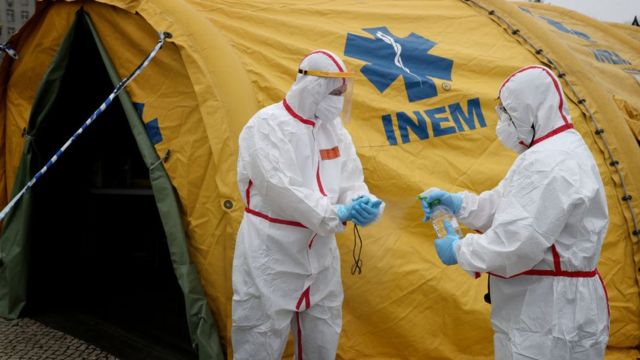
Lisbon had to resort to field hospitals in the face of the dramatic increase in cases of covid-19
Last week, three people were unable to get places in field hospitals and had to be transferred by helicopter to the island of Madeira, in Portugal - the archipelago is located more than 960 km from the Lisbon region, where the patients were initially located.
The public health system in Portugal has 850 beds in Intensive Care Units (ICUs) for people with covid-19. There are also 420 beds for patients with other diseases.
With a total of 865 patients with covid-19 receiving intensive care and 6,800 in clinical beds, Portuguese hospitals are without beds. In addition, there is also a shortage of doctors and nurses.
Many Portuguese health professionals went to other European countries, mainly the United Kingdom, where there are better salaries.
The holiday season, "pandemic fatigue" and the British strain
In the first wave of cases, Portugal had covid-19 rates much lower than the countries around it. Now, the big question is: how did the country get to the current situation?
For public health specialists, there are some factors that explain the current situation. Among them there is a relationship in social interactions during the year-end vacation - a period when movement was allowed throughout the territory and there was no limit in relation to family reunions - and the spread of the British coronavirus lineage.
"In November, we had acceptable values for the incidence of new cases. There were no uncontrolled figures," explains Carla Nunes, director of the National School of Public Health at Universidade Nova de Lisboa.
"What we believe has happened is that people have made small changes in their behavior, in the sense of being more permissive," adds Nunes in an interview with BBC Mundo (BBC's Spanish service).
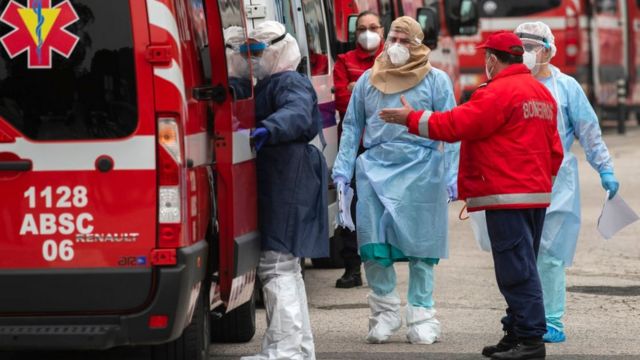
Coronavirus cases and deaths soared in January in Portugal
Elisabete Ramos, a professor at the Institute of Public Health at the University of Porto, points out that activities during the holiday season, which she highlights are considered important for local culture, are among the most relevant factors to explain the dramatic increase in cases in the country.
The expert adds that the current scenario is also impacted by the cold, which forces people to close the open environments that receive the public - facilitating the transmission of the virus.
Ramos points out that there is also a "pandemic fatigue" that causes people to follow restrictive measures less.
"Everyone is tired. Although the restrictive measures are similar, we do not see the same level of confinement on the streets as there was last March," he explains.
"This is the downside of having had good results so far: we have minimized the perception of risk and we believe that we can break some rules because nothing will happen."
"(The Portuguese) were very responsible (in the spring) because they were in a panic with what had happened in Spain and Italy", points out Nunes. "People were willing to lose what they had to lose because it was that or death. That perception is no longer that way."
"All of this came together with the new variant, which at that time (at the end of the year) we did not know about its presence in Portugal", adds Nunes.
At Christmas time, many Portuguese who migrated to the United Kingdom usually return to their country of origin, as do the British who have homes in the Portuguese country.
"At the time when many people were returning, at the (Portuguese) airports there were no specific measures ... what was happening was a little hidden (about the new variant)", says Nunes.
On January 28, Portuguese Prime Minister Antônio Costa stated that the British variant of the new coronavirus already had a prevalence of 32% across the country and in Lisbon alone accounted for 50% of cases.
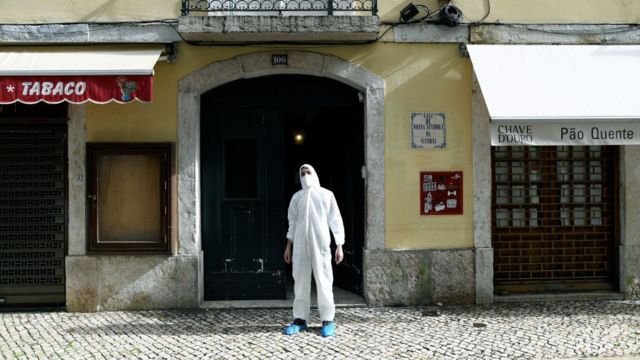
European country has had tough containment measures since January 15
In mid-January, Portugal suspended flights from the United Kingdom and Brazil, due to the new strain of coronavirus discovered at the beginning of the year in Manaus (AM). At least until the beginning of this week, there was still no record of the Brazilian or South Africa variant in Portugal.
International help
The current situation has led the Portuguese government to ask for help abroad. The call has already been answered by Germany and Austria.
The German Ministry of Defense announced on Sunday (31/01) that it will send a team of doctors to Portugal.
A plane with 26 doctors and nurses and 50 artificial respirators will head towards Lisbon this Wednesday (03/02), according to a statement from the German ministry.
Austrian Chancellor Sebastian Kurz announced that the country will receive Portuguese patients who need intensive care.
"It is a requirement of European solidarity to help quickly and without bureaucracy to save lives. Austria has already accepted intensive care patients from France, Italy and Montenegro during the pandemic. And now it will also accept intensive care patients from Portugal," wrote Kurz on your Twitter profile.
The Portuguese undersecretary of State and Health, Antônio Lacerda Sales, admitted last Monday the possibility of transporting patients to other countries, if hospitals in Portugal are unable to attend them.
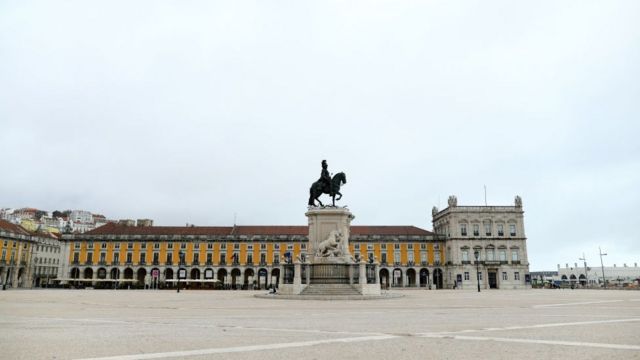
Since January 31, the Portuguese can leave only for essential activities
The experts heard by BBC Mundo consider that the Portuguese health system has reacted well since the beginning of the pandemic and only at the present moment has it reached its limit.
"The deficit in the health system - as in relation to beds and health professionals - is common to all countries, because the set of needs is growing," says Ramos. "With such a huge impact, it was easy for our system to get worse," he adds.
"But, in fact, it has adjusted very well, because throughout the year we have been finding solutions and only at this moment is it at its limit", he adds.
Hardening of measures
Faced with the current situation, the Portuguese authorities opted for new measures of social isolation to try to stop the spread of the new wave of coronavirus.
Since January 15, authorities have stepped up country health measures. Last Sunday, actions became even more rigid to ensure that the Portuguese stay at home.
Residents can only leave their homes for activities such as working - as long as teleworking is not possible -, buying essential goods, going to the doctor, helping the elderly or dependents, playing outdoor sports alone and taking short walks, during which time it is it is prohibited to stay in parks or sit on benches.
The government has stepped up police surveillance and agents may even require proof of residence for people to prove that they are strolling around their homes.
Schools have been closed since January 22, when classes were suspended for 15 days.
In addition, the Portuguese will not be able to leave for 14 days by any means (air, land, rail, sea or river), except to return to their home, live abroad, or to be close to their family.
The current situation has caused Portugal to reestablish land border controls with Spain. Despite this, the two countries guarantee that it is not a question of closing borders, but of establishing limits.
Regarding the control of airports, travelers from other countries with more than 500 cases per 100 thousand inhabitants must currently present a PCR test with a negative result carried out up to 72 hours before departure and remain in quarantine for 14 days after arriving in the country.
In renewing the state of emergency last week, the country's president, Marcelo Rebelo de Sousa, recently reelected, called for responsibility.
"What we do until March will determine what will happen in the spring, in the summer and, who knows, even in the fall."


No comments:
Post a Comment