Military coup in Myanmar: why now and what to expect in the near future?
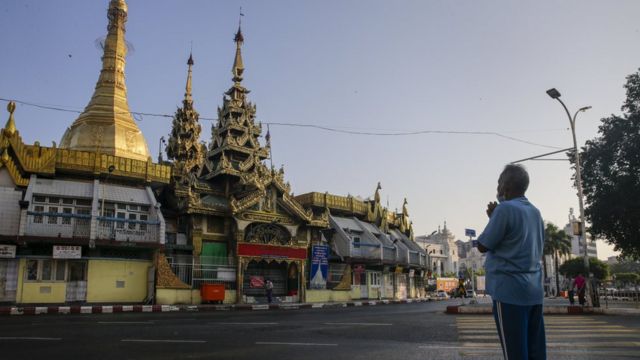
Army detained civilian politicians hours before Parliament met
Myanmar's military announced they had taken control of the country, a decade after agreeing to hand over power to a civilian government.
The coup spread fear across the country, which endured almost 50 years of oppressive military governments before the move to democratic government in 2011.
The arrests of Aung San Suu Kyi and other politicians recalled days that many hoped they had left behind.
For the past five years, Suu Kyi and his party, once banned National League for Democracy (NLD), led the country after being elected in 2015 in the most free and fair vote in 25 years. On Monday morning (1/2), the party was due to start its second term. The exact timing of the coup can be easily explained, points out Jonathan Head, BBC correspondent in Southeast Asia.
Monday morning should have been Parliament's first session, which in turn would have enshrined the result of the November elections. This will no longer happen.
In the elections, the NLD won over 80% of the vote, remaining immensely popular even in the face of accusations of genocide against the country's Rohingya Muslims.
The opposition, backed by the military, immediately started making accusations of fraud after the vote. The claim was repeated in a signed statement and released by the newly installed incumbent president to justify imposing a one-year state of emergency.
"The UEC [electoral commission] failed to resolve major irregularities in voter lists in the multiparty general election held on November 8, 2020," said Myint Swe, a former general who had been a vice president.
But there is little evidence to support the claim.
"Obviously, Aung San Suu Kyi won a resounding election victory," said Phil Robertson, deputy director of Human Rights Watch (HRW) in Asia. "There have been allegations of electoral fraud with no evidence."
Still, Robertson describes the scam as "inexplicable". "Did [the election] mean a loss of power? The answer is no."
Embarrassing the 'father of the nation'
Even though in the November vote the Solidarity and Development Party of the Union (USDP), supported by the military, received only a small fraction of the votes, the military still has a great influence on the government, thanks to the controversial constitution of 2008.
Not only does it give the military a quarter of parliamentary seats automatically, but it also gives them control over three important ministries - Interior, Defense and Borders.
Therefore, as long as the Constitution remains the same, the military maintains some control over the country. But could the NLD, with its majority, have changed the Constitution?
Improbable, says Jonathan Head, as this requires 75% support from Parliament, an almost impossible task because the military controls at least 25%.
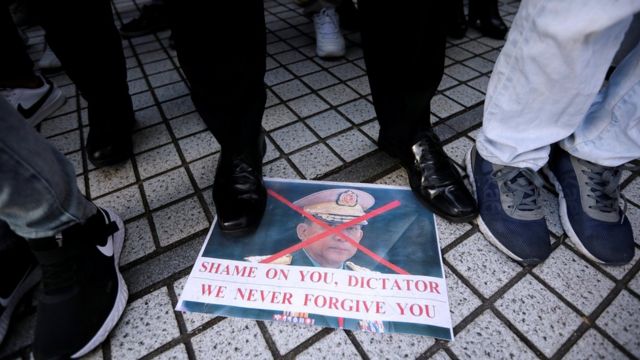
Myanmar citizens in Japan have already taken to the streets to protest the coup
Aye Min Thant, a former journalist, suggests that there may be another reason for today's action: embarrassment on the part of the military. "They did not expect to lose (the election)," he told the BBC.
Of course, there's a lot more at stake than that.
"You need to understand how the Army views its position in the country," adds Aye Min Thant. "International media often refer to Aung San Suu Kyi as the country's 'mother'. The Army considers itself the nation's 'father'."
As a result, he feels he has an "obligation and right" to govern - and in recent years, as the country has become more open to international trade, he has not liked what he has seen. "They see foreigners especially as a danger."
The pandemic and international concerns about the Rohingya's disenfranchisement in the November vote may have encouraged the military to act now, suggests Aye Min Thant. Even so, it still caused surprise.
What does the future hold?
In fact, experts seem unsure about exactly why the military has acted now, as there seems to be little to gain.
"It is worth remembering that the current system is tremendously beneficial for the Army: it has complete autonomy of command, considerable international investment in its commercial interests and political protection for war crimes," said Gerard McCarthy, a postdoctoral fellow at the Asia Research Institute. from the National University of Singapore to the BBC.
"Taking power for a year, as announced, will isolate non-Chinese international partners, damage the military's commercial interests and trigger an escalation of resistance by millions of people who have given Suu Kyi and the NLD in power another mandate to govern."
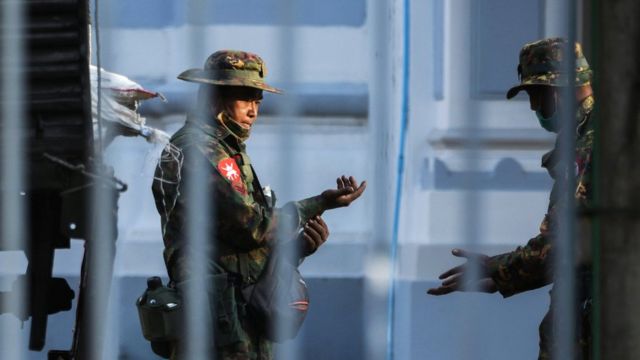
Soldiers were seen inside Yangon Prefecture
Perhaps, he says, they hope to improve the USDP's position in the next elections, but the risks involved in their actions "are significant.
Phil Robertson of HRW points out that the measure puts Myanmar at risk of becoming a "pariah state" once again, while irritating its citizens.
"I don't think the people of Myanmar are going to take that well," he added. "They don't want to go back to a military regime. They see Suu Kyi as a bulwark against the return to military power."
There is still hope that this can be resolved through negotiations, but he adds: "If we start to see the start of major protests, we will enter a major crisis."
Activist and military
Suu Kyi is the daughter of Myanmar's independence hero, General Aung San, murdered when she was just two years old.
After periods living in India, Japan, Bhutan and England, she returned to her native country in 1988, a turbulent year in Myanmar's history.
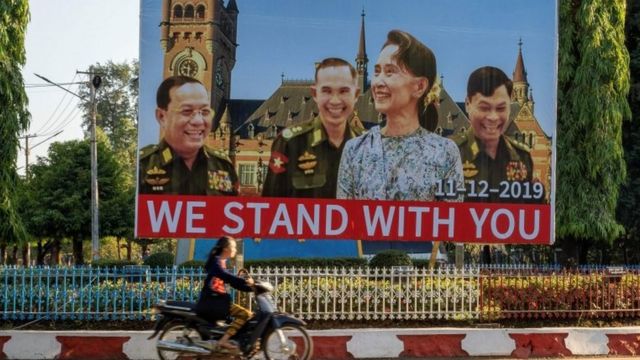
Aung San Suu Kyi is still a very popular leader in his country
Thousands of students, workers and monks took to the streets to call for democratic reforms. And Suu Kyi was quickly raised to the rank of leader of a revolt against then-dictator general Ne Win.
Inspired by the campaigns of civil rights leaders Martin Luther King in the USA and Mahatma Gandhi in India, she organized rallies and traveled around the country, calling for peaceful democratic reform and free elections.
But the demonstrations were brutally suppressed by the army, which seized power in a coup on September 18, 1988.
The military government called for national elections in 1990, and Suu Kyi's party won the election, even though she was under house arrest and was prevented from participating in the vote.
But the junta refused to hand over power, and has remained in control of the country ever since.
Suu Kyi was imprisoned between 1989 and 1995. During her imprisonment, she participated in secret meetings with the military government and paved the way for dialogue between the authorities and the opposition.
In 2015, with her party's victory in the general election, she became the most powerful figure in the government, which would have increasingly widened disagreements with the military and finds echoes in the 2021 coup. This is because Suu Kyi is banned the Constitution prevents her from becoming president for having foreign children, but from 2015 she became the first State Councilor and government chancellor, becoming the de facto leader of the country, even though she did not exercise control over the command. military.
In recent years, his leadership has been shaken on the international stage by the treatment of the Muslim minority Rohingya.
In 2017, thousands of Rohingya fled to Bangladesh, a neighboring country, due to the army's crackdown on deadly attacks on police stations in Rakhine State.
Former Suu Kyi international supporters have accused her of doing nothing to prevent rape, murder and possible genocide by refusing to condemn the military or acknowledge reports of atrocities. Before the International Court of Justice, an instance of the United Nations (UN), she publicly denied the accusations of ethnic cleansing against the Rohingya Muslim minority .
For some analysts, Suu Kyi's nationalist offensive in defense of the country in the face of international criticism has extended its popularity to the general election in November 2020.
Within the country, however, "the Lady", as Suu Kyi is known, remains quite popular with the Buddhist majority who have little sympathy for the Rohingya.
International reaction
The United States condemned the coup in Myanmar, saying that Washington "opposes any attempt to alter the outcome of the last elections or prevent Myanmar's democratic transition."
American Secretary of State Antony Blinken called for the release of all government officials and civil society leaders.
"The United States is with the people of Burma in their aspirations for democracy, freedom, peace and development. The military must reverse these actions immediately."
In the UK, British Prime Minister Boris Johnson also condemned Suu Kyi's coup and "illegal arrest".


No comments:
Post a Comment