Women's Day and how did it start being celebrated?

Celebrations in Chandigarh, India on March 8, 2021
You may be seeing International Women's Day being mentioned in the press or hearing comments about it.
But what is this date for? When is it? Is it a celebration or a protest? Is there such an equivalent as an International Men's Day? And what events will happen this year?
For over a century, March 8 has been identified around the world as a special date for women.
How did it start?

Clara Zetkin suggested the creation of International Women's Day in 1910
International Women's Day originated in the labor movement and has become an annual event recognized by the United Nations (UN).
Its seeds were sown in 1908, when 15,000 women marched through New York City demanding shorter working hours, better wages and the right to vote. A year later, the Socialist Party of America declared the first National Women's Day.
The proposal to make the date international came from a woman named Clara Zetkin, a communist activist and women's rights advocate.
She came up with the idea in 1910 during an International Conference of Socialist Women in Copenhagen. There were 100 women from 17 countries present, and they unanimously agreed to her suggestion.
The date was first celebrated in 1911 in Austria, Denmark, Germany and Switzerland. And her centenary was celebrated in 2011 — so this year, we're technically celebrating the 111th International Women's Day.
But International Women's Day was only made official in 1975, when the UN began to commemorate the date.
And it has become an occasion to celebrate the advancements of women in society, politics and the economy, while its political roots mean that strikes and protests are organized to raise awareness of continuing gender inequality.
2. Why March 8th?

International Women's Day Event in Bogotá, Colombia, 2021
Clara's proposal to create an International Women's Day did not have a fixed date.
The date was only formalized after a wartime strike in 1917, when Russian women demanded "bread and peace"—and four days after the strike, the Tsar was forced to abdicate, and the Provisional Government granted women the right to vote. .
The women's strike began on February 23, according to the Julian calendar used in Russia at the time. This day corresponds to March 8 in the Gregorian calendar — and that's when it's celebrated today.
3. Why do people use the color purple?
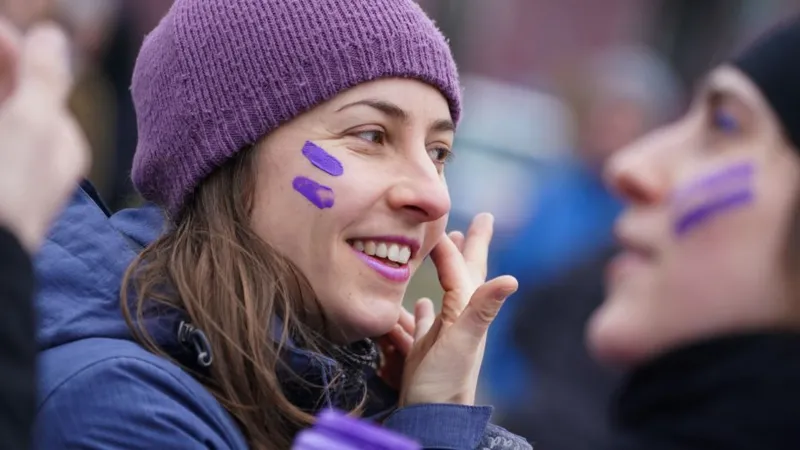
The color purple is often associated with the date as it stands for 'justice and dignity'
Purple, green and white are the colors of International Women's Day, according to the official website.
"Purple stands for justice and dignity. Green stands for hope. White stands for purity, although it is a controversial concept. The colors originated from the Women's Social and Political Union (WSPU) in the UK in 1908," they say.
4. Is there an International Men's Day?
Yes, there is November 19th.
But the date was only created in the 1990s and is not recognized by the UN. It is celebrated in over 80 countries around the world, including the UK.
This day celebrates "the positive value men bring to the world, their families and communities," according to organizers, and aims to highlight positive role models, raise awareness of men's well-being and improve gender relations. The theme for 2021 was "Better Relationships Between Men and Women".
5. How is International Women's Day celebrated?

Vaccination center in Rome, Italy, offered mimosas to women last year
International Women's Day is a national holiday in many countries, including Russia, where flower sales double for three to four days around March 8.
In China, many women are given a half day off on March 8, as recommended by the State Council.
In Italy, International Women's Day, or La Festa della Donna , is celebrated with the delivery of mimosa buds. The origin of this tradition is unclear, but it is believed to have started in Rome after World War II.
In the US, March is Women's History Month. Every year, a presidential address honors the achievements of American women.
This year, the celebrations will continue to be a little different because of the covid-19 pandemic and virtual events should take place all over the world, including the UN.
6. What is the theme of 2022?

Last year, Kamala Harris was sworn in as the first woman, first black, and first Asian-American vice president of the U.S.
The UN has announced that its theme for 2022 is "Gender Equality Today for a Sustainable Tomorrow". Their events will recognize how women around the world are responding to climate change.
But there are also other themes. The International Women's Day website — which it says was created to "provide a platform to help bring about positive change for women" — has chosen the theme #BreakTheBias and is asking people to imagine "a world free from bias, stereotypes and discrimination".
7. Why do we need this?

Women's groups in Mexico transform railings into makeshift memorial for victims of femicide
We have witnessed a significant setback in the global struggle for women's rights in the past year. The Taliban's resurgence in August changed the lives of millions of Afghan women—girls were banned from high school, the country's Ministry for Women's Affairs was dissolved, and many women were told not to return to work.
In the UK, the murder of Sarah Everard by a police officer on duty has reignited debates over women's safety.
The Covid-19 pandemic also continues to have an impact on women's rights. According to the World Economic Forum's Global Gender Gap Report 2021, the time taken to close the global gender gap has increased by one generation, from 99.5 years to 135.6 years.

Women take to the streets to celebrate — and protest
A 2021 study by UN Women based in 13 countries showed that nearly 1 in 2 women (45%) reported that they or a woman they know had experienced some form of violence during the pandemic.
This includes abuse that is not physical, with verbal abuse and denial of basic resources being the most common reported.
Despite concerns about the coronavirus, rallies took place around the world on International Women's Day last year.
In Mexico, women's groups turned metal railings, erected to protect the National Palace, into a makeshift memorial for victims of femicide.
In parallel, women in Poland staged protests across the country following the introduction of a near-total ban on abortion in January 2021.

Abortion rights activists celebrate Colombia's 2022 achievement
End of Podcast
In recent years, however, there have been advances—especially with regard to female leadership.
Kamala Harris became the first female, first black, and first Asian-American vice president of the US in 2021.
In the same year, Tanzania swore in its first female president, Samia Suluhu Hassan, while Estonia, Sweden, Samoa and Tunisia all had female prime ministers for the first time in history.
In January 2022, Xiomara Castro was sworn in as the first female president of Honduras.
In 2021, New Zealand approved paid leave for women (and their partners) who have suffered a miscarriage or stillbirth. In 2020, Sudan criminalized female genital mutilation.
And we can't help but talk about the impact of the #MeToo campaign, denouncing experiences of sexual harassment and assault. It started in 2017 but is now a global phenomenon.
In January 2022, a university professor in Morocco was sentenced to two years in prison for indecent behavior, sexual harassment and violence after university students broke their silence about the sexual favors he had demanded in exchange for good grades — a series of scandals. of this type has tarnished the reputation of Moroccan universities in recent years.
In the past year, there have also been advances in relation to abortion in several countries. In February 2022, Colombia decriminalized abortion in the first 24 weeks of pregnancy.
In the US, meanwhile, abortion rights have been restricted in some states, with Texas banning procedures starting at six weeks of pregnancy.


No comments:
Post a Comment